ADVOCACY
Cora Beth believes that Classics can and should be more inclusive, and champions initiatives which advance this.
As an autistic academic, a single parent and a first generation student from a working class background, Cora Beth is passionate about widening access to students of all backgrounds, by reducing barriers, promoting open access and online resources, and supporting lifelong learning.
Latest open access publications
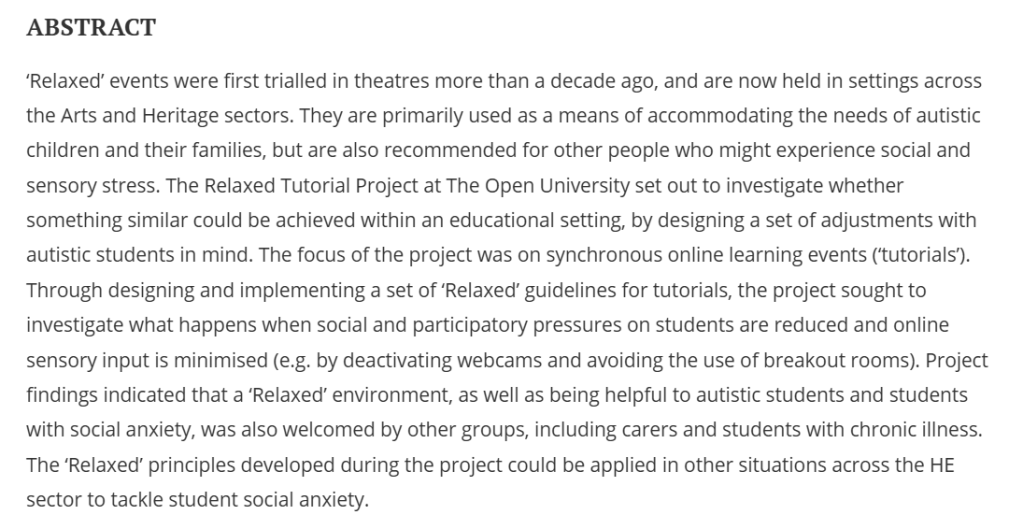
Fraser, C. B., Yamagata, N., & Mac Mahon, A. (2025). The relaxed tutorial project: designing synchronous online tutorials for autistic students. Open Learning: The Journal of Open, Distance and e-Learning, 40(4), 425–438. https://doi.org/10.1080/02680513.2025.2530595
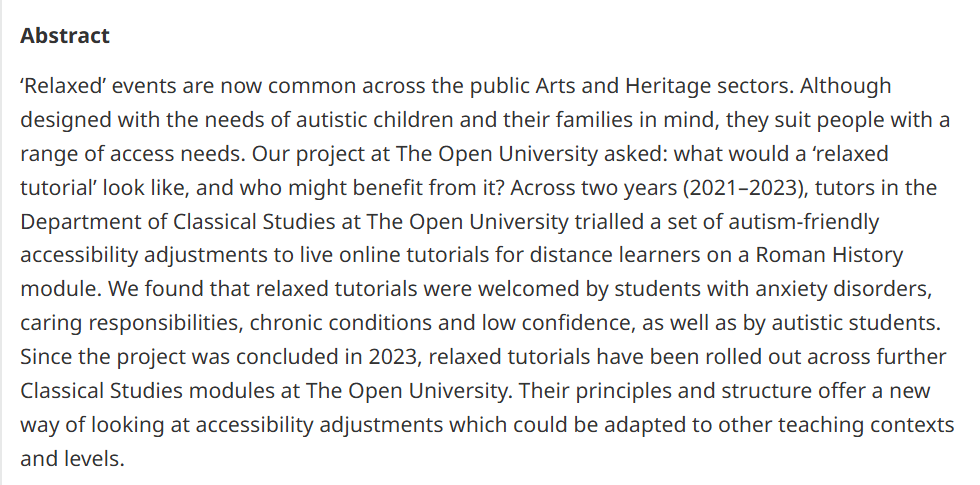
Fraser, C. B., Yamagata, N., & Mac Mahon, A. (2025). The Relaxed Tutorial Project: distance learning and anxiety in Classical Studies. Journal of Classics Teaching, 26(51), 94–98. doi:10.1017/S2058631024001004

Invited Talks (recorded)
‘An autistic classicist in the Labyrinth’: talk for the California Classical Association South, 05/11/2022.
Autism Masterclass at HISTCHILD2021: Children and Young People Speaking Up and Speaking Out Online Conference – The Biennial Conference of the Children’s History Society at Manchester Metropolitan University, 16-19/06/2021.
Recent and Ongoing Advocacy Projects
fraut
fraut is an app designed to support the parents of autistic children by providing explanations, tried-and-tested suggestions, and resources to use and share.
NESTL Oxford
A project team at Oxford University has developed a free-to-use toolkit to support neurodivergent-inclusive teaching and learning. Cora Beth was an Advisory Board member and contributed to the project.
Working Class Classics
Cora Beth is proud to be associated with three new groups representing Working Class Classics: Working Classicists; the Network For Working-Class Classicists; and Class Acts.
RepAut
RepAut is an app designed to make difficult situations easier for autistic people. Cora Beth has been working with GP Dr Tony Mohammed to develop this medical app, with an education version planned for the future.
Signum
Working with other members of the Asterion team, Cora Beth is developing the Signum Project, an initiative to improve accessibility for neurodivergent people attending in-person conferences and events.
Previous EDI Roles
Founder and Director of Asterion
Asterion is the first organisation in Classics dedicated solely to celebrating and supporting neurodiversity. Covering schools, colleges, universities and the academic workplace, Asterion offers resources and community to all who might benefit.

Women’s Classical Committee Co-Chair
The WCC UK is run by a steering committee. All members of the committee are very happy to be contacted about ideas for future activities, events, and your ideas for the future of the WCC UK. You can email us at womensclassicalcommittee [at] gmail.com.
CUCD EDI Committee
Cora Beth served on the Council of University Classics Departments EDI Committee, which aims to foster and amplify diverse and marginalised voices within Classics, from 2021 to 2025.
Recent Advocacy Writing
Making Neurodiversity Visible in Classics
As an autistic classicist, one of the things I’ve always struggled with is social interaction. In class, I teach students about Bourdieu and habitus and cultural scripts, while all the time feeling that, whatever the cultural script of our time is, mine got lost in the mail. I’ve spent my life pretending (without much success) to understand people and the codes that underpin their actions. The easiest solution for me has always been to hide because, when I’m on my own, I’m not uncomfortable, awkward, or afraid.
But hiding sends the wrong message and models the wrong behavior, as I realized when my son was diagnosed with autism, too. How can you advise a child to pretend to be like everyone else, because difference makes them a target? How can you warn them that their honesty will make them an outcast, their sensitivities will make them vulnerable, and their hyperempathy will make them a victim? How can you commit to inclusion in your professional life while accepting exclusion in your personal life?

Asterion: Neurodiverse Classics
Over the last few months, several OU Classical Studies students and graduates have been involved in setting up a new organisation called Asterion, which aims to represent neurodiversity in Classics.
For the OU Classical Studies Blog, Asterion Director and OU tutor Cora Beth Fraser caught up with two neurodivergent members of the Asterion Editorial Board, Hilary Forbes and Tony Potter, to talk about neurodiversity, OU study and Asterion.
Cora Beth: In setting up Asterion, I’ve been hearing a lot of late-diagnosis stories from people who’ve only found out in adulthood that they are neurodivergent. For many people the diagnosis explains traits and problems that go back a long way. It certainly has done for me. After I was diagnosed as autistic in my 30s, I could look back at my childhood and see all the quirks and difficulties that would have added up to an obviously autistic profile, if I hadn’t been trying so hard to hide them, and if autism hadn’t been so little understood in those days! How about you: when did you first realise that you experienced the world a little differently?
ACCLAIM Interviews: Dr Cora Beth Fraser
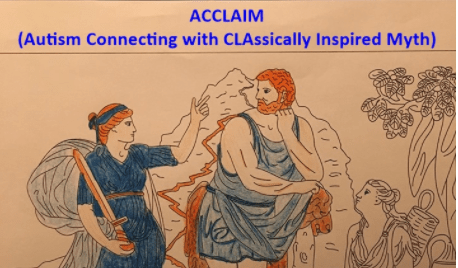
Hello everyone, I am Adam Soyler I am a student at Roehampton university studying history. One of my modules required me to find a work placement. While looking for a placement I came across the Autism and Classical Myth project which uses classical mythology to help and stimulate autistic children in line with the Our Mythical Childhood project and the ACCLAIM Network. The project offered me a work placement and one of my tasks was to interview members of the Network. I hope you enjoy the questions and answers that were produced!!!!
In April 2021, I interviewed Cora Beth Fraser who teaches Greek and Roman Myth (among other topics) at the Open University. Cora Beth has always been interested in the intersection of Classics and Education. She graduated from Newcastle University in 2005 with a PhD in Classics, and gradated at the same time from the Open University with an MEd specialising in Primary Education. Cora Beth now has a third master’s degree too, with a particular focus on online accessibility. She is currently very actively interested in autism and learning.
Hello Cora Beth. My first question is: What got you interested in Greek and Roman mythology?
Difference and Perspective in Myth, with Cora Beth Fraser
In October, Peopling the Past brings you interviews and reflections from scholars whose work investigates monsters and demons in the ancient world, examining their meaning and symbolism and their deeper connections to human experiences past and present.
At Peopling the Past we occasionally feature interviews with educators and researchers who have founded amazing new projects dedicated to making history, archaeology, and related subjects more inclusive.
Can you tell us about Asterion and how it came about?
Asterion is a new organisation dedicated to representing and celebrating neurodiversity in Classics, based primarily in the UK, but with contributors from around the world. There are a lot of neurodivergent people in Classics, Ancient History and Archaeology, but we tend to be scattered. I’m autistic; but until recently I’d never met another classicist who was. The same goes for people with OCD, and ADHD, and dyspraxia, and dyscalculia, and lots of other differences. Because we’re often isolated, we tend to work through our problems alone – but recently a few of us got together and wondered if there might be a way to help one another.
 Cora Beth Fraser